“Racism” versus “Intersectionality”? Significations of Interwoven Oppressions in Greek LGBTQ+ Discourses

Abstract

This paper seeks to make “racism” strange, by exploring its invocation in the sociolinguistic context of LGBTQI+ activism in Greece, where it is used in ways that may be jarring to anglophone readers. In my ongoing research on the conceptualisation of interwoven oppressions in Greek social movement contexts, I have been interested in understanding how the widespread use of the term “racism” as a superordinate category to reference forms of oppression not only based on “race,” “ethnicity,” and “citizenship” (e.g., racism, nationalism, xenophobia) but also those based on gender, gender identity, and sexuality (e.g., sexism, transphobia, and homophobia) relates to the increased adoption of “intersectionality” in movement discourses. In ordinary parlance, this commonplace usage of “racism” as an “umbrella term” nevertheless retains its etymological link to “race,” while its scope is extended to other regimes of superiority/inferiority or privilege/oppression. If intersectionality presupposes that oppressions are ontologically multiple and analytically separable, the use of “racism” as an umbrella concept seems to point in the other direction, implying that all forms of oppression originate from a common source, have a similar ontological basis, or generate privilege for the same social agents who deploy similar tactics vis-à-vis oppressed groups. My research examines how intersectionality – widely understood as a multi-axial theory of oppression, which contends that power relations are multiple, distinct, and irreducible to one another, yet converge simultaneously in the experiences of multiply oppressed social groups – relates to the use of “racism” as a struggle concept in Greek, but also in other languages commonly used in Greece, such as Albanian (racizmi) and Arabic (eunsuria).In this paper, I examine how these two vocabularies – of racism and intersectionality – are operative in movement discourses, but also how they shape and are shaped by activists’ perceptions, analyses, and theories of oppression.

Black Feminist Statement

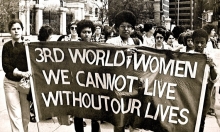
In 1977, the Combahee River Collective, a radical Black feminist group, published the "Black Feminist Statement", which had a great influence on the formation of feminist, left, and socialist thought. The "Black Feminist Statement" has appeared in the context of hitherto crucial discussions about the homogeneity of the feminist movement, disregard of racism and xenophobia, as well as the problematic issues of white liberal feminism. The Statement questioned such universal categories as "woman" and "global sisterhood." Speaking out against capitalism, hetero-patriarchy, racism, and liberal individualism, the activists of the Combahee River Collective sought to find new forms of collective imagination, public space, radical queer politics, and freedom. In the post-Soviet context, this Statement remains mostly unknown. We think that the Statement articulates important theorizing, which, although produced in the geographical west, provides examples of radical feminist imagination and resistance. The translation of the Statement into Russian can create a space for comprehension of transformative radical solidarities, as well as for reflection on the relations between post-Soviet feminist practices and racial, colonial, and imperial formations. The Combahee River Collective emphasizes the importance of centering the marginal experiences of people of color, whose bodies and identities are a constant target of attacks, neglect, and systematic violence, as well as a major resource exploited under the global capitalist regime.

Read the complete translation in Russian.

Listen to an audio version of the Statement .
Hegemony in Post-Soviet Georgia: Types of Nationalisms and Masculinities

Pages7